
Whale watching through an Ahousaht lens By Erin Linn McMullan
As the boat leaves the dock, Captain Richard Thomas says he likes to begin every tour with a history of the ʕaḥuusʔatḥ (Ahousaht) People. He is soft-spoken and affable, carrying the knowledge, stories, and songs of generations, along with a drum made for him by his daughter, to share with the guests of Ahous Adventures. “The way I like to present my tours is to share a little bit about our People, the way we’re living in the past, when the only transport was dugout canoes and we didn’t have the privilege of engines—no motors, no gas.”
Clayoquot Sound, where Grey whales, Humpbacks, and kakaw̓ in (Orcas) co-exist, has been stewarded by Nuučaan̓ uł Peoples since time immemorial.
In spring, whale watching routes depend on weather, waves, and ensuring the safety of the herring spawn.
If the seas are rough, Captain Richard may take the inside by Vargas Island towards Cow Bay, where the Grey whales love to feed, and if they’re not there, continue further to Ahous Bay.
“I always like to make sure our guests have the best experience. If they’re looking for whales, I want to find them a whale,” relaying he has seen as many as eight feeding together in Cow Bay.
“I love to sing,” he shares, explaining he will often sing on entering Cow Bay, showing respect by maintaining the 100-metre required distance. Sometimes the whales respond, and he turns off his motor, describing being surrounded as “whale soup”.
Guest reviews show appreciation for his generosity: “Captain Richard, who was born and raised on this land, shared his deep knowledge and connection to the ocean and nature with such pride and joy. You can really feel his spirit and the love he has for his home and culture.”1
Now entering his fourth season with Ahous Adventures but with a lifetime of experience on the water, Captain Richard is delighted to have already seen Grey whales, who he emphasizes are often underrated, breaching seven times.
While in spring most Eastern North Pacific Grey whales (Eschrichtius robustus) migrate north from Baja California, Mexico and Central America, Captain Richard explains about five percent of the population remains year-round in Clayoquot Sound, estimating there are 260–280 whales who are resident to the area.
“Orange Crush (CSG859) is one who stays here now, she was first documented here in 1977.” Often feeding closer inshore at the entrance rocks to Cow Bay, in front of Surf Beach, and around Whaler Island, she has a distinctive “two-toned port flank and bright white dash mark very close to the first knuckle on her starboard side.”2
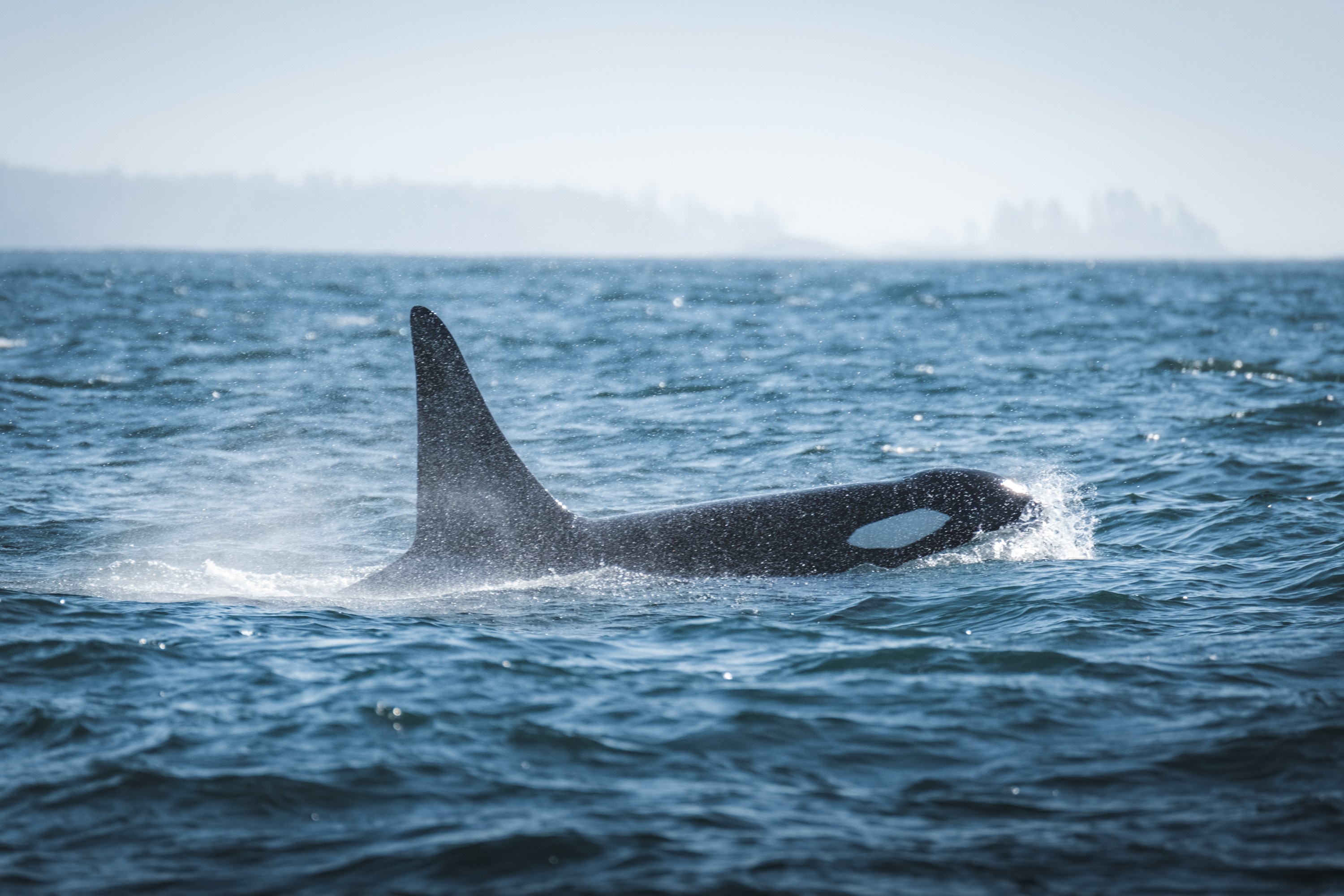
Always keen to learn, Captain Richard is quickly improving his Grey whale identification, more familiar with Biggs (transient) Orcas like Rainy (T011A). First documented here in 2018, Rainy, now 48, travels solo since losing his mother Wakana (T011) in 2019. At 8.3 meters (27.25 feet), he is considered the biggest Orca in west coast waters and perhaps ever recorded. “I’m always happy to run into the big guy.”
Whale sightings shared over the radio sometimes offer new insight into the relationship between baleen whales (Greys and Humpbacks) and toothed Orcas.
“I was with two or three boats following a pod of Orca,” recalls Captain Richard, “on the inside near Cat Face five miles out from Cow Bay.” At the same time, a Grey whale near the bay’s entrance rocks was reported behaving strangely, heading straight for shallower waters. A feat he explains through echolocation: the Grey whale must have detected the Orcas’ high-frequency squeaks and whistles underwater.
He’s excited about an upcoming four-day naturalist course which will continue building on his already expansive local knowledge.
“I’ll tell our guests a little about the whaling history of our People and the stories my grandfather told me,” shares Captain Richard. Many of these stories are captured in his grandfather, Peter Samson Webster’s book, As far as I know: reminiscences of an Ahousaht Elder.3
In the book, his grandfather shares a story his father used to tell:
If I recall correctly, there were eight men in the canoe. Each man had a special job. In addition to the main hunter, who threw the harpoon, there were paddlers, one man to see that the tough cedar ropes did not tangle and another to look after the air bags made from hair seal skin and to tie them on the main harpoon line. These bags were used to float the whale after it was killed.
During my father’s journey they harpooned a whale near Bartlett Island between Vargas and Flores Islands. The whale towed the men in their canoe to the waters off Wickaninnish Bay. A glance at the map will show this to be a considerable distance.
They speared the whale again. Instead of the whale weakening, it headed due south with the canoe still in tow.
At last, the whale died. When it did the men were so far out to sea that only the tops of the snow-capped mountains were visible on the horizon. Before they could tow the whale into shore they ran out of food and water.
A chance meeting with seal hunters helped them. These paddled to the shore and returned with provisions sufficient to last the men until they completed the tow.
It would appear that the entire pursuit took two weeks from the beginning to the end. For the last few miles, they were joined by more than a dozen canoes from such places as Blunden and Vargas Islands. These shared the towing of the whale to shore….4
čikaatius (Tyson Atleo), co-owner of Ahous Adventures and a hereditary representative of the ʕaḥuusʔatḥ Nation, has pointed out that Ahousaht is amidst an “historical transition” as a Nuučaan̓ uł whaling culture rebuilding its relationship with Ihtuup (the whale) through eco-tourism.5
ʕaḥuusʔatḥ guides like Captain Richard are essential to bridging past and present to share Ahousaht culture with the world.
“Sometimes I’ll sing as we’re returning to the harbour,” Captain Richard emphasizes, “I want our guests to have an experience they’ll never forget.”
1 “Meaningful experience with Ahous Adventures”, Nikie J., Oct. 2025, Tripadvisor.
2 Grey Whales of Clayoquot Sound: a quick ID guide for mariners.
3 Webster, Peter S. 1983. As far as I know: reminiscences of an Ahousaht Elder. Campbell River Museum and Archives, Campbell River, B.C.
4 p. 24, “‘Oo-Simch’ and the Whale Hunt”, Ibid.
5 “Celebrating the return of the whales”, March 2, 2024.