
A deep history-filled journey to Mux̣wšiƛa (Hot Springs Cove) with Captain David Frank As told to Erin Linn McMullan
I traveled with my spouse and daughter to the Tofino area at the beginning of May, 2026. My daughter and spouse booked the Hot Springs tour. This is a local Indigenous-run business. The trip to the Hot Springs requires a boat trip. The captain was David. He spent time telling people about the local Indigenous history and sharing his knowledge about the land and local wildlife. Since the Hot Springs are on Indigenous territory the tour group has daily first access before the other larger non-Indigenous tour groups. The site itself was spectacular. The water was very warm. To and from the site the group was able to see sea otters, whales, and sea lions.
This is a great business, and I highly recommend Ahous Adventures.
—Jose L, May 2026, travelled with family.
More than a bucket list adventure to the natural wonder of geothermal pools and waterfalls set oceanside within sculpted rock, the Mux̣wšiƛa (Hot Springs Cove) in Nism̓aakqin Park, northwest of Flores Island in Clayoquot Sound, is a journey through the storied ʕaḥuusʔatḥ haḥuułii.
In Nuučaańuł, Mux̣wšiƛa means “steaming from rock” and Nism̓aakqin “our land that we care for”. ʕaḥuusʔatḥ Peoples have stewarded Nism̓aakqin since time immermorial.
Ahous Adventures’ Tofino Hot Springs Eco-tour is Captain David Frank’s favourite because he can take guests on the scenic route he learned from his uncle qaamiina Sam (Edwin Sam) and “share the history I was taught growing up.”
“I try my best to make guests feel welcome,” he emphasizes, crediting his father’s brother, qaamiina Sam, as his mentor and “still a great role model”, who also taught him to break the ice with humour.
“When I travel my ancestors’ route, the scenic route, it actually brings peace to my life,” Captain David says with reverence.
As the youngest sibling, and third-youngest first cousin in one of ʕaḥuusʔatḥ’s largest families, Captain David Frank has always been curious about history and is continuously learning more, especially since taking on his role at Ahous Adventures.
What he has learned through his wife’s family, who come from maańuʔisʔatḥ, is that the pools were used much as they are today for soaking in the hot springs.
A path once connected mux̣wšiƛa to ʔapsuḥta (“where the trail ends”) at the village of ʕupnit (“place where it is always calm”), the primary village of the maańuʔisʔatḥ People.1
The maańuʔisʔatḥ were amalgamated into ʕaḥuusʔatḥ after the “Long War” in the 1800s.2
These traditional hot springs are now managed by ʕaḥuusʔatḥ, who have taken steps to ensure protection of its sensitive environment and cultural significance and to enhance visitors’ experience with exclusive morning access for the Nation and for Ahous Adventures’ guests.
Overseen by ʕaḥuusʔatḥ Stewardship Guardians, the marine park’s new Visitor Use Management Strategy, was implemented in 2025 and developed with the province of BC as part of the 2021 Ahp-cii-uk Agreement, which translates as “going the right way, together”.
It’s integral role in ʕaḥuusʔatḥ culture endures from harvesting the area’s rich biodiversity to healing and ceremony.
Probably the best and the most informative excursion I have ever been on. It was unbelievable to hear all of David’s stories and be able to see everything that we did while on the trip. The hot springs were amazing, and every component of the whole adventure absolutely blew me away. I will for sure be recommending Ahous to everyone I know.
—Kyle B.
Enriched by Captain David’s generous sharing of knowledge, you arrive at Nism̓aakqin, your anticipation building as you hike the 2-kms-long cedar boardwalk under a canopy of old-growth Western Hemlock and Western Red Cedar. As you cross the bridge, rising steam from the geothermal vent hints that your destination is near.
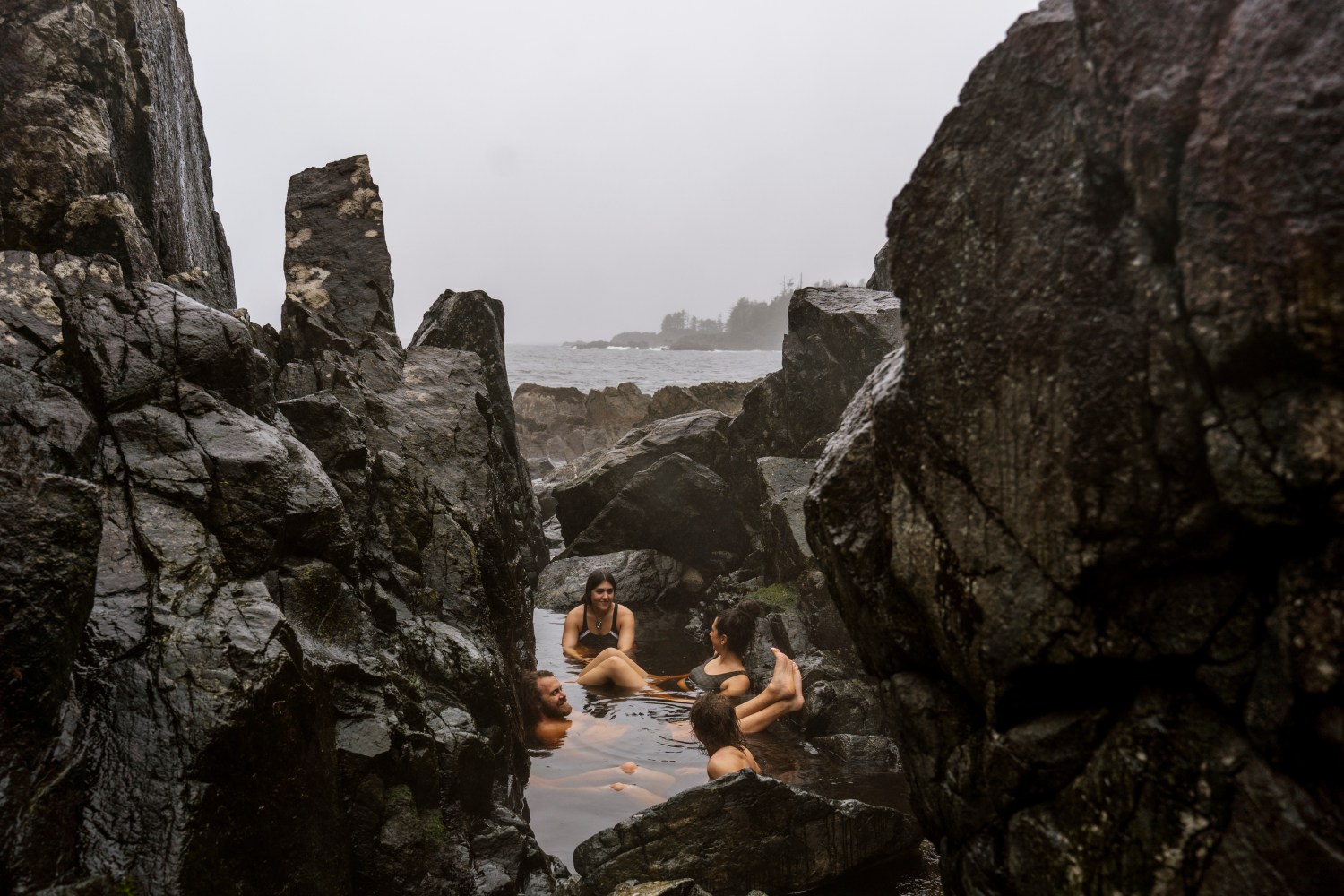
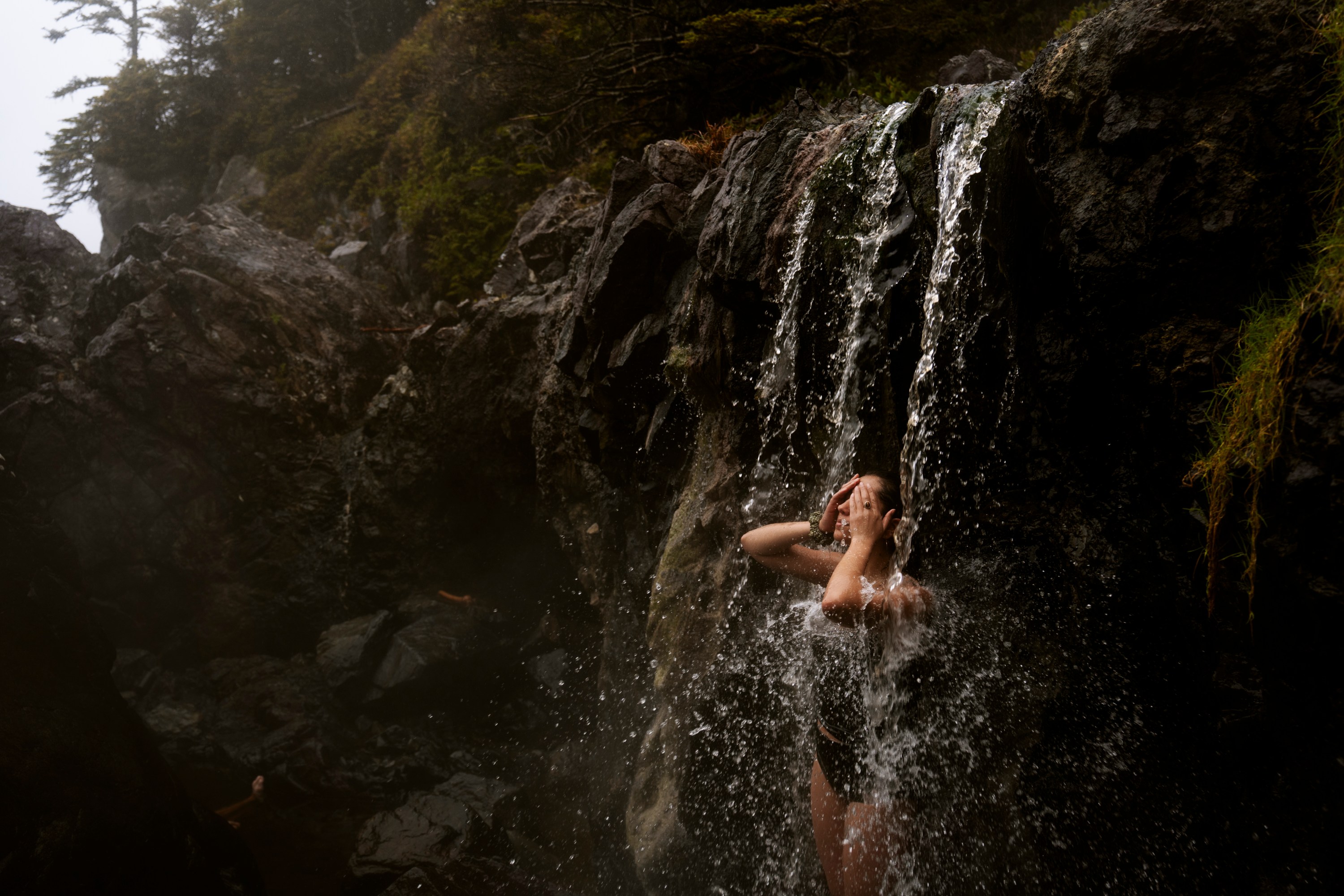
Mux̣wšiƛa features waterfalls, superheated through a fracture in Jurassic-aged quartz-diorite quartz-diorite and cascading into six pools of mineral-rich waters qaatsis (cawts-iss) “bubbling and boiling”. The lower pools are replenished by refreshing intertidal swells. Unaltered, soaking in these 50°C natural springs feels timeless, connecting you to the pulse of the Pacific, the heartbeat of this ancient place.
On the journey home, Captain David focuses on spotting abundant marine life in blue carbon-rich Clayoquot Sound, with the kakaw̓in (orcas) he grew up seeing as the main attraction. He shares with his guests his grandfather’s wisdom and knowledge about kakaw̓in – “handed down to my uncles and also my cousins – all through family roots” – a knowledge that is sacred.
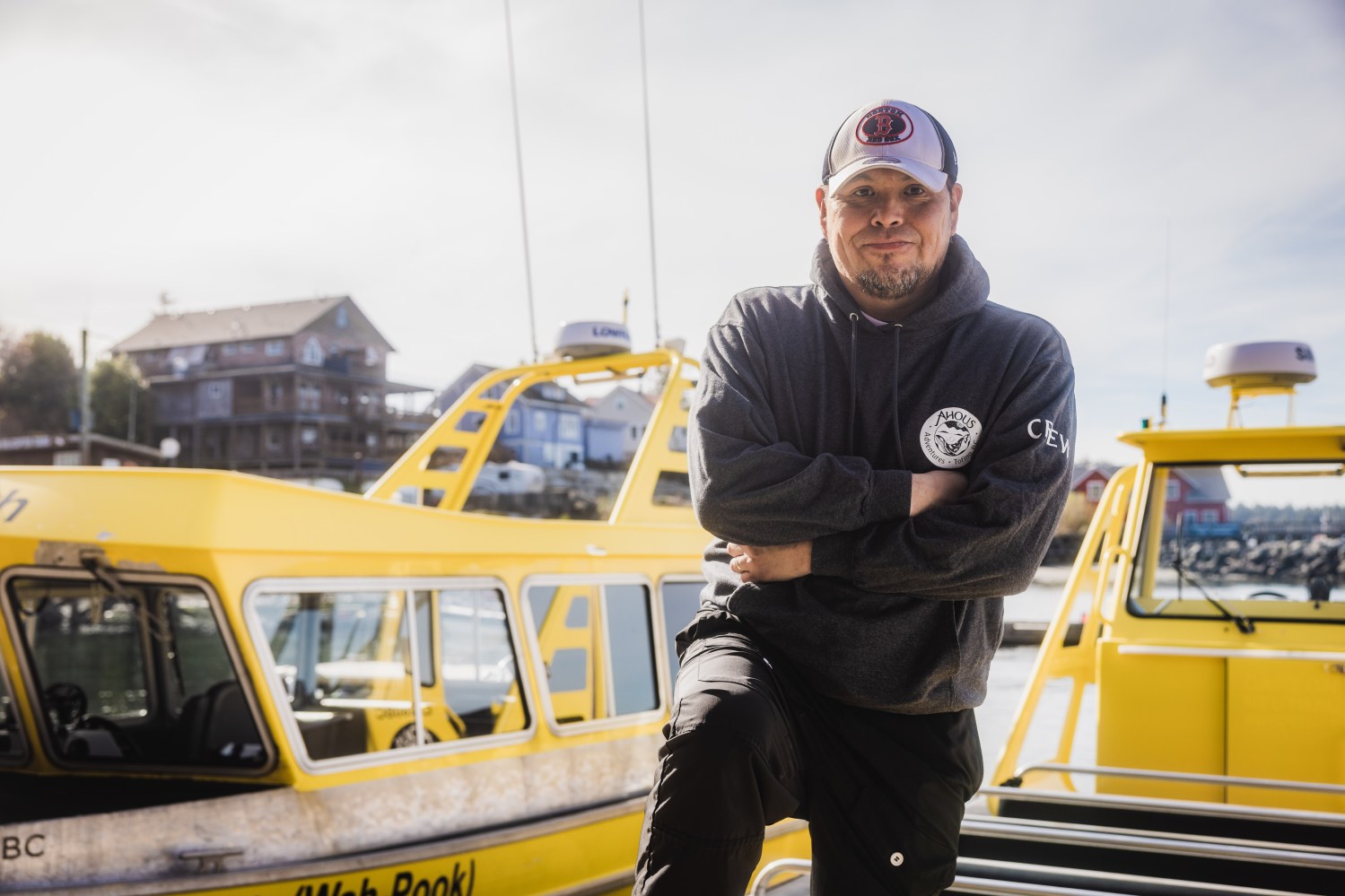
Carrying forward his grandfather’s name, he points out that he is one of five generations of David Franks: “my grandfather, my father, myself, my only son, and his only son.” As he relays this, he is on “grandpa duty” at home in ʕaḥuusʔatḥ.
Kakaw̓in, protected by Nuučaan̓uɫ law, were never hunted by ʕaḥuusʔatḥ and over the past 30 years, members of the Nuučaan̓uɫ Peoples who call Clayoquot Sound home have contributed to ongoing research about their presence here.
Captain David enjoys taking his guests past Cleland Island – a bird sanctuary and favoured Steller sea lion habitat. “One bird I try to look out for is the Tufted Puffin,” he says, explaining that visitors are often surprised to discover these pelagic seabirds, who spend most of their lives over open ocean, here.
He describes the resilient sea otters, who were once extirpated from the BC coast and now number approximately 5,000 as his “favourite little animals”.
“When I’m looking for marine life, I listen on radio or ask co-workers before I leave Hot Springs, ‘Any sign of whales in the area?’
“On Saturday, I actually got to witness a humpback breaching six times. I noticed the first big splash from a quarter-mile away,” he shares with wonder. “It was a good way to end the tour for my last crew.”
He enunciates the Nuučaan̓uɫ phrase he has just learned, “ʔiiḥtuup tich tich knee”, describing a whale’s heartbeat.
While Captain David only began seeing humpbacks, along with Grey whales, after joining Ahous Adventures, his family history connects him to the last whale hunter, his uncle, Edwin Frank.
“I love telling the whaling stories of my father’s brother,” says Captain David, “being the last whale hunter in our community and out of our large family. My father once told me he wanted his legacy to be known.”
When speaking of humpbacks as “giving beings—beings imbued with significant spiritual power who make incredible contributions to our society,”3 ʔikaatius Tyson Atleo, the company’s co-owner and a hereditary representative of ʕaḥuusʔatḥ, described their evolving relationship with whales now through eco-tourism.
“Our family’s reverence for the legacy of and alignment to supernatural law is very important to us,” ʔikaatius stressed, personally coming from a whaling ancestry through his great-great-great grandfather Keesta, the last generation in his family to practice whaling along with Keesta’s late-grandson-in-law Edwin Frank.4
“It brings me joy knowing that the world gets to know what my ancestors accomplished,” effuses Captain David, reflecting that his family are proud of him for working for Ahous Adventures.
He is daily striving to create his own legacy through sharing the history and beauty of his homelands with visitors from around the world.
“I don’t mind sharing our history with the world,” he underscores, “That’s what the world would like to know about.”
- p.6, Nism̓aakqin Park Mux̣wšiƛa Hot Springs Area Visitor Use Management Strategy, April 2025: https://nrs.objectstore.gov.bc.ca/kuwyyf/nismaakqin_park_mux_si_a_hot_springs_visitor_use_management_strategy_c284544c7e.pdf.
- While Peter Samson Webster recounts that this “fierce war” took place in the 1840s or 1850s, lasting 15 years (p. 60, in As Far As I Know: Reminiscences of an Ahousaht Elder, 1983), Earl Ḿukʷina George, who consulted with both Webster and Ahousaht historian, John Jacobson, dates the war as having begun much earlier, already underway with night raids by the Otsosaht and growing “fiercer somewhere around 1800” (p. 44, in Living On the Edge: Nuu-Chah-Nulth History from an Ahousaht Chief’s Perspective, 2003). Recent validated land claims describe Ahousaht territory as having been “won in war from the Otsosaht in the early 1800s” (Ahousaht First Nation v. Her Majesty The Queen In Right Of Canada, 2019: https://decisions.sct-trp.ca/sct/rod/en/item/362821/index.do).
- “Celebrating the Return of the Whales”, March 2, 2024: https://tinwis.ca/celebrating-the-return-of-the-whales/.
- Ibid.